
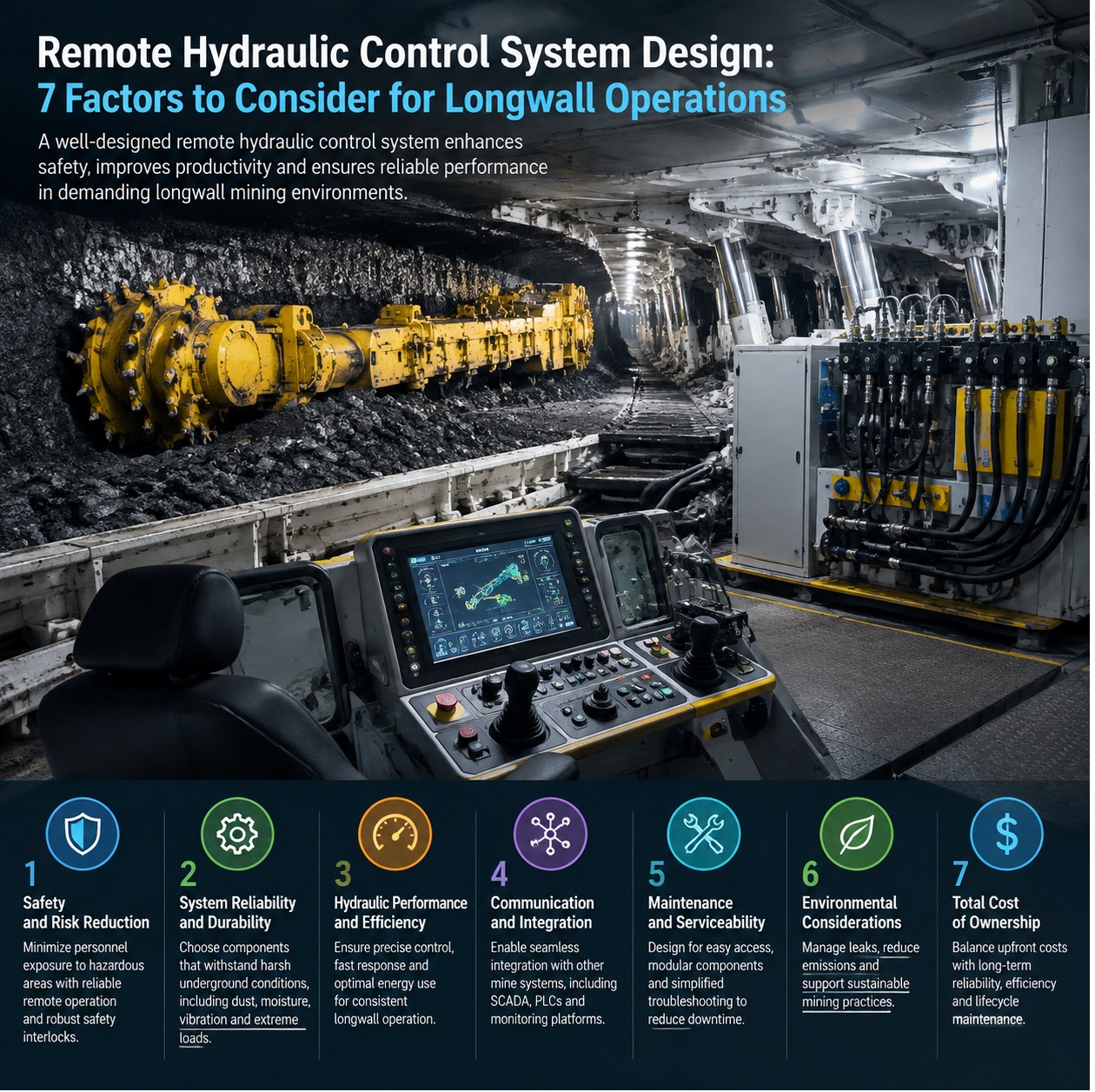
 A longwall face is a terrible place to discover your remote hydraulic control system was designed for a nice clean factory floor.
I have seen a control package with glossy brochures turn into a maintenance nightmare because nobody asked where the pressure spikes would go, how the operator would react when comms dropped, or what happens when the shield advances into a roof that refuses to behave. If you are specifying remote hydraulic controls for a longwall, these seven factors separate a system that supports production from one that becomes another downtime category.
- Deterministic latency, not average ping
Every vendor will quote you a latency number. Most of them are lying with statistics. A 40 millisecond average sounds excellent until the 95th percentile is 300 milliseconds and the operator is trying to sequence 200 shields while the shearer keeps moving. Longwall hydraulic control is not a web application. It is a real-time physical process with roof loads, conveyor interfaces, and human reaction times stacked on top of it. Design for worst-case jitter, not demo-case averages. Keep safety-critical loops at the edge. Use redundant network paths, managed switches, and quality of service rules that prioritize valve commands over dashboard telemetry. If the control decision depends on a round trip to a surface server, you have already lost the face.
- Rugged enough for the actual mine, not the datasheet
Longwall equipment lives in a slurry of dust, water, emulsion, vibration, and electromagnetic noise. The shearer motors, AFC drives, and variable frequency drives are not polite neighbors. A remote hydraulic control system has to survive all of it. That means sealed enclosures, armored and strain-relieved cables, positive-locking connectors, and galvanic isolation on I/O. It means testing for conducted and radiated emissions before the first shield is installed. It also means paying attention to methane and dust ratings. Intrinsic safety and explosion protection are not paperwork exercises. If the enclosure needs a clean-room technician to open it, it is the wrong enclosure. If the connector can be kicked loose by a miner crawling past, it will be.
- Hydraulic compatibility from the valve out
Remote control does not fix a mismatched hydraulic circuit. It exposes it. You need to know the pressure and flow characteristics of every shield, the response time of the valves, the emulsion quality, and the contamination tolerance of the components. A remote system that fights the existing hydraulic design is just a remote way to lose cycle time. Pay attention to pressure drop across manifolds, pilot pressure requirements, filtration, and relief settings. If you are retrofitting older shields, do not assume the new electronic controller can simply drive the old valves. Sometimes it can. Sometimes it needs a different pilot interface, a pressure compensator, or a complete manifold replacement. The best design starts with the hydraulic schematic, not the HMI mockup